| Lotus 900 series |
|---|
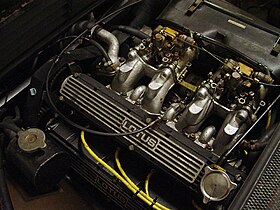 |
| Overview |
|---|
| Manufacturer | Lotus Cars |
|---|
| Layout |
|---|
| Configuration | I4 (Types 904, 905, 906, 907, 910, 911, 912, 920)
V8 (Types 909, 918) |
|---|
| Cylinder block alloy | Iron (Types 904, 905)
Aluminium (all others) |
|---|
| Cylinder headalloy | Aluminium |
|---|
| Valvetrain | DOHC |
|---|
| Combustion |
|---|
| Fuel type | Gasoline |
|---|
| Chronology |
|---|
| Predecessor | Lotus-Ford Twin Cam |
|---|
The Lotus 900 series is a family of internal combustion engines designed and built by Lotus Cars of Hethel in the United Kingdom. Successor to the Lotus-Ford Twin Cam, the 900 was the first complete engine developed by Lotus. The engine was built from 1972 to 1999.
Background
As early as 1964 Lotus recognized the need to find a replacement for the Lotus Twin Cam engine.Colin Chapman issued a brief that listed the features wanted in a new engine, including `high efficiency, flexibility, torque and smoothness which was suitable for hand assembly'. Unable to find this combination in any existing engine the company used outside consultants and internal resources to define the characteristics of the next Lotus engine. After having rejected a 120° V6 as too wide for Lotus' chassis and a 60° V6 as too tall for their bodywork, the engineers determined that a 2-litre inline-four engine was the optimal choice. This future engine would have four valves per cylinder (16 valves total) operated by belt-driven dual overhead cams and develop 150 hp (112 kW). The block would be angled 45° from vertical to permit a lower bonnet and simplify development of a 4-litre V8 version for future use in Indianapolis racing.
The design team was headed by Steve Sanville, Lotus' Head of Powertrain Development, and Ron Burr, formerly of Coventry Climax. Even though the team was able to complete the design for the new cylinder head and start work on the engine block and crankshaft it became apparent that Lotus' racing program and concurrent move to a new larger factory would limit the resources available for the new engine project.
Vauxhall
At the 1967 Earl's Court Motorshow Vauxhall unveiled their new Victor FD model. The car included an all-new Vauxhall Slant-4 engine that shared many characteristics with the engine Lotus was developing. The Vauxhall engine was an inline 4 cylinder engine with a belt-driven overhead camshaft. The block was slanted at 45° from vertical and a V8 was planned but never realized. Most importantly for Lotus, the bore centres of the Vauxhall slant-4 were the same as those Lotus had determined for the 900 series.
After seeing the new engine at the show Chapman arranged a meeting with John Alden, Vauxhall's Engineering Director, where he negotiated the purchase of ten 1975 cc slant-4 blocks and four complete engines.Lotus would accelerate development of the 900 engine by using the Vauxhall iron blocks as test-beds for their new cylinder head while design of their own engine block was under way.
[2]:38 For their test engines Lotus installed a crankshaft with a slightly longer stroke.
After it became known that Lotus was using Vauxhall's iron block in their engine development program the rumour began to circulate that the Lotus engine was based on the Vauxhall design, even through the 900 series was entirely a Lotus design.
Later Vauxhall used Lotus' cylinder head as a starting point for the design of their own DOHC cylinder head for the slant-4 block. Until that head was available some Vauxhall rally cars used the Lotus cylinder head on the slant-4 block.
Engine development
As design of the new engine began Lotus saw the need for a new sports car engine for endurance races of between 800 and 1600 kilometres. This prompted the company to split the 900 project into two versions; one with smaller ports and a 51° included angle between the valves for touring applications and one with larger ports and a 41° included angle for racing. Tony Rudd, Engineering Director for Lotus, identified the following six engine types created or planned during in the early stages of development and production:
- Type 904 — Iron block 2 litre racing engine with fuel injection.
- Type 905 — Iron block 2 litre touring engine.
- Type 906 — Sand-cast aluminium block 2 litre racing engine with fuel injection.
- Type 907 — Die cast aluminium 2 litre touring engine.
- Type 908 — Aluminium 4 litre racing engine.
- Type 909 — Aluminium 4 litre touring engine.
Early testing of the type 904 engine did not reveal any fundamental deficiencies, although problems with the horizontally-mounted distributor vibrating and the timing belt jumping off the inlet cam were identified. The Vauxhall blocks developed cracks around their main bearing bolt bosses, so a special batch were made with thicker castings, which change was applied to all subsequent slant-4 blocks.
The 905 engine experienced wear on the connecting rod against the crankshaft webs, which was solved by boring rather than honing the bushing on the small end of the con-rod so that it held more oil. Vibration problems with the distributor, mounted vertically on the 905, appeared on this engine as well, and it was found that a larger battery was needed to start the larger engine. Mechanical noise from the engine and noise from the air intake were excessive. The engines were road tested in a Vauxhall Victor and a Vauxhall Viva GT (registration number RAH 713F).
Lotus invested ₤550,000 in a new machining facility for the new engine, and a series of changes were made to the design to adapt it to the numerically-controlled milling machines. One change was to split the case along the crankshaft centre-line and incorporate a separate one-piece bearing cap and engine skirt girdle. This change eliminated the need to machine deep main bearing saddles and restored some stiffness to the block assembly. The camshaft housings were kept separate from the cylinder head assembly, which simplified machining operations.
Development of the touring engine diverged into a version for the United States and another for the home market and the rest of the world. The main differences were in the carburettors used and compression ratios. Engines for the US received Zenith Stromberg carburettors and an 8.4:1 compression ratio due to emissions requirements and California law penalizing engines with ratios above 8.5:1. Engines destined for the UK and Europe had Dell'Orto carburettors and a 9.5:1 compression ratio. Pistons for UK and European engines were flat-topped and fly-cut for valve relief, while Federal engines had an additional indentation milled out of the centre of the piston top.
Twelve sand-cast aluminium engines were made and installed in the test fleet vehicles, which were joined by a Bedford CF van that continued to be used for deliveries while testing the engine.The alloy blocks were mechanically noisier than the iron engines. Another issue was that the alloy blocks used wet liners which were poorly supported in the initial design and this caused a high rate of cylinder head joint failures. This was dealt with by increasing the torque loading on the studs and increasing the thickness of the liners. An electrolytic corrosion issue was dealt with by changing to a stainless-steel gasket and using a chemically inhibited coolant. The engine tended to show low oil pressure at idle which, while not dangerous, was expected to worry car owners and was solved by installing an oversized oil pump.
While preparing engines for Jensen other problems came to light. Transmission vibration thought to be caused by insufficient beam stiffness in the engine/transmission assembly was addressed by adding two lugs to the lower edge of the crankcase. Two oil-related problems surfaced. The first was oil being introduced into the air box during sustained high-speed cruising. An external oil-separating breather was added until the housing for the rubber-lip crankshaft seal could be re-shaped into an oil-separator chamber, which became the permanent solution. The other problem, which was seen under similar conditions, was that the oil pressure would drop precipitously. This was caused by oil being held up in the cam boxes and not draining back into the sump. This was due to mismatched drain holes, casting flash, and sticking or incorrect relief valves. The short-term solution was to phosphate the camshafts, and the other causes were dealt with as assembly problems.]
Jensen-Healey
The engine was complete by 1970 but Lotus' existing cars could not be adapted to use the new engine and Project M50 would not become the Elite Type 75 for several more years.At the same time Norwegian-American businessman Kjell Qvale had taken a controlling interest in the Jensen Motors company and teamed up with Donald Healey of Austin-Healey fame and his son Geoffrey Healey to design a car to be called the Jensen-Healey using Vauxhall Viva GT components. They were looking for a suitable engine for the car, having decided that the Vauxhall slant-4 would not be powerful enough after being certified for US emissions.
Chapman approached Qvale and offered to supply Jensen with 60 of Lotus' new 900 series engines per week. This initial offer was declined but after a second offer by Chapman Jensen announced in October 1971 that they would be using up to 15,000 Lotus 907 engines per year in the Jensen-Healey. The engine would be certified to 1973 Federal standards but use the European Dell'Orto carburettors and produce 140 hp (104 kW).
The 900 series engine first appeared in production form as the Lotus 907 with the March 1972 debut of the Jensen-Healey. It was the first mass-produced multi-valve engine available to the general public, appearing one year before the 16-valve SOHC Triumph Dolomite Sprint and three years before the 16-valve DOHC Chevrolet Cosworth Vega.
The engine in the Jensen-Healey experienced a series of problems. In addition to a high rate of oil consumption, distorted cylinder liners occurred.An updated Jensen-Healey Mk2 was introduced late in 1973 that had a revised engine with a redesigned crankcase, but by this time though the car had acquired a reputation for poor reliability and sales never reached expected levels.Production of the Jensen-Healey ended in 1976, but by this time Lotus was using the type 907 in their own cars.
Chrysler/Talbot
In 1977 Desmond "Des" O'Dell, Director of Motorsport for Chrysler UK, approached Chapman about having Lotus supply a 900 series engine for a special project.O'Dell wanted to develop a rally version of the Chrysler Sunbeam to take up the competition role formerly filled by the Chrysler Avenger.It would be competing against the then-dominant Ford Escorts.
The engine Lotus supplied had the same 95.28 mm bore as the 907 but at O'Dell's request displacement was increased to 2174 cc by lengthening the stroke to 76.2 mm. Tony Rudd developed a flexible flywheel to dampen increased vibrations from the larger size. This engine was called the type 911. In 1978 Chrysler sold their European operations to the PSA Group, so when car the car debuted in 1979 it was called the Talbot Sunbeam-Lotus. Ultimately 2298 road-car versions were sold.
In the rally car the 911 engine was tuned to produce 250 bhp (186 kW; 253 PS). Driver Henri Toivonen won the RAC Rally in 1980, and teammates Guy Frequelin and Russel Brookes were third and fourth. The next year the car won the Argentine Rally and placed second at Monte Carlo, Portugal, Corsica, Brazil and San Remo, winning the 1981 Championship of Makes for Talbot and earning Frequelin second place in the Drivers series.
Work began on a Group B Talbot Horizon as a possible successor to the Talbot Sunbeam-Lotus.This car had the same type 911 engine but instead of the front-engine, rear-wheel-drive layout of the earlier car the new car was a rear mid-engine, rear-wheel-drive layout. Only two prototypes were built before the project was cancelled.
900 series engine models
Type 904
The type 904 engine was used by Lotus in two Type 62 cars which raced for one year in 1969 and were then sold. This hybrid engine used a Vauxhall Slant-4 iron block and the Lotus DOHC aluminium cylinder head with Tecalemit-Jackson fuel injection. The engine was available under two marketing designations; LV220 and LV240, where `LV' stood for Lotus/Vauxhall and 220 and 240 stood for the power developed by the respective versions. There are pictures of the LV240 with two 2-barrel downdraft carburettors.
Bill Blydenstein, the Team Manager for Dealer Team Vauxhall (DTV), acquired several Lotus heads and other parts to build LV/240 engines for use in DTV's rally cars, including the famous "Old Nail" Firenza among others.
Vauxhall later went racing in Group 4 with the Vauxhall Chevette HS. The road-going versions used the Vauxhall DOHC cylinder head but early rally cars used the Lotus head on a 2300 cc block. These early HS models were homologated with the Lotus head in November 1976 before the requisite 400 cars had been built.A rule change in 1978 by FISA made the Lotus-head cars ineligible to compete and Vauxhall switched to their own DOHC head.
The 904 LV/220 and LV/240 also appeared in Daren Cars' Mk3 in the early 1970s.
Applications:
- 1969 Lotus 62
- 1971 Vauxhall Firenza (`Old Nail' rally car - received engine in 1973)
- 1976 Vauxhall Chevette HS (rally version)
- 1971-73 Daren Cars Mk3
Type 905
The type 905 engine was first run on a test-bed for the production road-car engine and was later installed in the test vehicles prior to the arrival of the first batch of aluminium blocks.
Applications:
- 1967 Vauxhall Victor (test vehicle)
- 1968 Vauxhall Viva GT (test vehicle)
- 1969 Bedford CF (test vehicle)
Type 906
The type 906 engine had a sand-cast version of Lotus' new aluminium block and Tecalemit-Jackson mechanical fuel injection. It was used in a Formula 2 open-wheeled car that had the same `Type 74' designation as the Lotus Europa Twin Cam and was commonly called the `Texaco Star'.The Formula 3 engines in the two Type 74 Texaco Stars were prepared by Novamotor in Italy and made 275 hp (205 kW).
Applications:
Type 907

Jensen-Healey with Lotus Type 907 twin-cam engine and Dell'Orto carburetors.
The type 907 was the first version of the 900 series to go into full production when it appeared in the Jensen-Healey in 1972. It began to appear in Lotus cars in 1975 in the Lotus Elite and was later used in the Lotus Eclat and Lotus Esprit. Bore was 95.28 mm (3.8 in) and stroke was 69.24 mm (2.7 in), for a total displacement of 1,973 cc (120.4 cu in). The angle between intake and exhaust valves was 38°. Ignition on early engines was provided by a Lucas points and coil system, which was replaced by a Lumenition system on later engines. Breathing through two 2-barrel carburetors, engine power figures for the Jensen-Healey version were 140 bhp (104 kW; 142 PS) and 155 bhp (116 kW; 157 PS) as used in the early Type 75 Elites. The 907 (and the subsequent 912) were offered in several levels of tune, called `specs', that ranged from 1 to 10 with different compression ratios and power outputs.
Even though they produced respectable power for their size and era, early 907s earned the nickname "the torqueless wonder" for their lack of bottom-end.
Applications:
- 1972-1976 Jensen-Healey
- 1975-1976 Jensen GT
- 1974-1980 Lotus Elite S1
- 1975-1985 Lotus Eclat S1
- 1975-1978 Lotus Esprit S1
- 1978-1981 Lotus Esprit S2
Type 909
The type 909 was a 90° V8 with a bore of 95.29 mm and a stroke of 70.30 mm and total displacement of 4,011 cc (244.8 cu in). While this 900 variant was mentioned in Rudd's original paper it only appeared in the Lotus Etna concept car that debuted at the Birmingham Motorshow of 1984. Power and torque were reported to be 335 hp (340 PS; 250 kW) and 295 ft⋅lb (400 N⋅m) respectively. The engine weighed 414.5 lb (188.0 kg).
Applications:
Type 911
The 2.2L type 911 debuted in 1978 with the same 95.28 mm bore as the 907 but with a stroke length of 76.2 mm. This enlarged 900 variant was designed by Lotus for Chrysler (later Talbot) and their Lotus Talbot Sunbeam rally and production cars. In road trim the type 911 engine produced 150 bhp (112 kW; 152 PS) @ 5750 rpm and 150 lb⋅ft (203 N⋅m) of torque @ 4500 rpm. In rally trim this was increased to 250 bhp (186 kW; 253 PS).
Applications:
- 1979 - 1981 Talbot Lotus Sunbeam
- 1982 Talbot Lotus Horizon (2 prototypes)
Type 912
The type 912 was a four cylinder naturally aspirated engine that Lotus began to use in their cars in 1980. The 912 shared its bore, stroke and 2174 cc displacement with the type 911 but had many internal enhancements, including redesigned camshafts, camshaft carriers and cam covers as well as a new sump, cylinder head and main bearing girdle. This engine was initially rated at 160 bhp (119 kW; 162 PS) @ 6500 rpm and 160 lb⋅ft (217 N⋅m) of torque @ 5000 rpm.
In October 1985 a high compression version of the 912 was released. The compression ratio was raised to 10.9:1, and the engine also received revised ports, new camshafts, new Mahle pistons and alloy cylinder liners with a Nikasil coating.Externally there were new cam covers with red paint. This engine developed 180 hp (134 kW) @ 6500 pm and 165 ft⋅lb (224 N⋅m) @ 5000 rpm.
Applications:
- 1981 Lotus Esprit S2.2
- 1981-1990 Lotus Esprit S3 and NA
- 1981 Lotus Eclat S2.2
- 1982 Lotus Excel
- 1986 Lotus Excel SE and SA
Type 910 and 910S
The type 910 was a turbocharged engine introduced in the Esprit Essex of 1980. Esprit development engineer Mike Kimberley and Turbo engine project manager Graham Atkin convinced Chapman to focus on maximizing torque at low engine speeds.
The compression ratio for the turbo engine was lowered from the 9.4:1 of the naturally aspirated engines to 7.5:1 by lowering the piston crowns and rings relative to the gudgeon pins. New camshafts that increased both lift and duration were added, as were sodium-filled exhaust valves and larger water passages in the cylinder head. The lower main-bearing girdle was made stronger. The installation included a larger radiator and higher-capacity water pump. A dry-sump system was fitted along with an additional scavenge pump and an oil cooler. The engine reverted to a wet-sump system in 1982.
The type 910 used a single Garrett AiResearch T3 turbocharger with maximum boost set to 0.55 bar (8.0 psi). Lotus kept the dual Dell'Orto 40 DHLA carburetors used on the non-turbo engines but opted to have the turbocharger blow through the carburetors, which necessitated pressure seals on the throttle spindles to prevent leaks in the pressurized air-fuel system. Output of the 910 engine was 210 hp (213 PS; 157 kW) @ 6250 rpm and 200 lb⋅ft (271 N⋅m) of torque @ 4500 rpm
In 1985 a "High Compression" (HC) version was released with new Mahle pistons. The compression ratio was up to 8.0:1 and maximum boost pressure had been raised to 0.65 bar (9.4 psi). Carburettors still delivered the air/fuel mix but they were now the larger Dell'Orto DHLA 45M model. These changes brought power up to 215 hp (160 kW) @ 6250 rpm and torque to 220 lb⋅ft (300 N⋅m) @ 4250 rpm. In markets with stringent emissions requirements the 910 became the first 900 touring engine to use fuel injection with the addition of a Bosch KE-Jetronic system in 1986. Peak power for the injected engine was the same as the HC carburetted version but came at a higher engine speed and peak torque dropped to 274 N⋅m (202 lb⋅ft).In mid-1989 the Bosch system was replaced by Delco GMP4 electronic fuel injection that included a crank-fired wasted spark ignition that eliminated the need for a distributor. Power for this version rose to 228 hp (170 kW) @ 6000 rpm and torque to 218 lb⋅ft (296 N⋅m) @ 4000 rpm.
In 1990 the engine was upgraded with an air-water-air intercooler that Lotus called a Chargecooler to become the type 910S. Maximum boost was raised again, this time to 12.4 psi (0.9 bar).The 910S appeared in the Esprit SE where it produced 264 horsepower (197 kW) and up to 280 hp (209 kW) for short intervals on overboost. Torque was 271 lb⋅ft (367 N⋅m) @ 3900 rpm.
The engine in the Sport 300, X180R and S4s used a new cylinder head cast by Zeus Aluminium Products and commonly known as the Zeus head. The revised head came with enlarged inlet valves and used a reprogrammed engine control module. The T3 turbocharger used had an larger impeller and maximum boost was up to 1 bar (14.5 psi). This version of the 910S produced 300 horsepower (220 kW), and was capable of propelling these cars to 60 mph in just over 4 seconds.
The type 910S was used in the limited-production Brazilian Emme Lotus 422T 4-door sedan from 1997 to 1999.
Applications:
- 1980-1990 Lotus Esprit Essex and Turbo
- 1990-1993 Lotus Esprit SE
- 1993 Lotus Esprit Sport 300 and X180R
- 1993-1996 Lotus Esprit S4
- 1995-1996 Lotus Esprit S4s
- 1997-1999 Emme Lotus 422T
Type 920
The type 920 engine had an overall displacement of 1,994 cc (121.7 cu in). Although not significantly larger than the 907, with a bore and stroke of 84.45 x 89 mm it was slightly undersquare, in contrast to the oversquare 907. The 920 was originally exclusive to the Italian market, where cars with engines smaller than 2.0 L fall into a lower tax regime. It would later be available in Portugal and Greece as well. The 920 was used from 1996 to 1999 in the Esprit GT3, with the improvements from the SE models making these cars good for 240 hp (180 kW). This was the last iteration of the 4-cylinder 900 series Lotus engine, which had a lifespan of nearly 30 years.
Applications:
- 1991-1992 Lotus Esprit (Italy only)
- 1996 Lotus Esprit S4 (VIN 42046, 42051 two (I am not sure) of three finally built)
- 1996-1999 Lotus Esprit GT3
Type 918
The type 918 is a 3.5 liter double-overhead cam (per bank) V8 engine with a flat-plane crankshaft. Although it carries a 9xx designation it is described as a clean sheet design.The engine had a bore of 83 mm (3.3 in) and a stroke of 81 mm (3.2 in) for a total displacement of 3,506 cc (213.9 cu in).Dry weight for the engine was 214 kg (471.8 lb). The 918's only production car application was in the Lotus Esprit V8.
Applications:
- 1996-2004 Lotus Esprit V8
Engine comparison table
| Type | Bore (mm) | Stroke (mm) | Displacement | Power | Torque | Fuel system | Induction1 |
|---|
| 904 | 95.25 | 69.85 | 1,991 cc (121.5 cu in) | 220 hp (164 kW) (LV/220)
240 hp (179 kW) (LV/240) | 160 lb⋅ft (217 N⋅m) | Tecalemit-Jackson fuel injection | NA |
|---|
| 905 | | | | | | | NA |
|---|
| 906 | 95.28 | 69.24 | 1,973 cc (120.4 cu in) | 275 hp (205 kW) | | | NA |
|---|
| 907 | 95.28 | 69.24 | 1,973 cc (120.4 cu in) | 160 hp (119 kW) (Europe)
140 hp (104 kW) (US) | 140 lb⋅ft (190 N⋅m) | 2 Dell'Orto DHLA 45E (European Elite)
2 Stromberg 175 CD-2SE (US Elite) | NA |
|---|
| 909 | 95.29 | 70.30 | 4,011 cc (244.8 cu in) | 335 hp (250 kW) @ 6500 rpm | 295 lb⋅ft (400 N⋅m)@ 5500 rpm | | NA |
|---|
| 911 | 95.28 | 76.2 | 2,174 cc (132.7 cu in) | 150 hp (112 kW) | 150 lb⋅ft (203 N⋅m) | | NA |
|---|
| 912 | 95.28 | 76.2 | 2,174 cc (132.7 cu in) | 160 bhp (119 kW) @ 6500 rpm
180 hp (134 kW) @ 6500 rpm (1986 Excel SA) | 160 lb⋅ft (217 N⋅m) @ 5000 rpm
165 ft⋅lb (224 N⋅m) @ 5000 rpm (1986 Excel SA) | | NA |
|---|
| 910 | 95.3 | 76.2 | 2,174 cc (132.7 cu in) | 210 hp (157 kW) @ 6250 rpm
228 hp (170 kW) @ 6000 rpm | 200 lb⋅ft (271 N⋅m) of torque at 4500 rpm
218 lb⋅ft (296 N⋅m) @ 4000 rpm | Bosch KE-Jetronic fuel injection
Delco GMP4 electronic fuel injection | T |
|---|
| 910S | 95.3 | 76.2 | 2,174 cc (132.7 cu in) | 264 horsepower (197 kW)
300 horsepower (220 kW) | 271 lb⋅ft (367 N⋅m) @ 3900 rpm | | T, I |
|---|
| 920 | 84.45 | 89 | 1,994 cc (121.7 cu in) | 240 hp (179 kW) @ 6250 rpm (1996 GT3) | 215 lb⋅ft (292 N⋅m) @ 3750 rpm (1996 GT3) | | T, I |
|---|
| 918 | 83 | 81 | 3,506 cc (213.9 cu in) | 350 hp (261 kW) @ 6500 rpm (1996 V8) | 295 lb⋅ft (400 N⋅m) @ 4250 rpm (1996 V8) | | T |
|---|
Note:
1"NA" = Naturally aspirated, "T" = Turbocharged, "I" = Intercooled. |


 English to Chinese BETA
 English to French
 English to German
 English to Italian
 English to Japanese BETA
 English to Korean BETA
 English to Russian BETA
  English to Spanish


![[Valid RSS]](valid-rss-rogers.png "Validate my RSS feed")


